Orxivar
Halo System
Halo System
Couldn't load pickup availability
Self-paced learning overview
- 📥 Digital file available after purchase
- ♾️ Long-term availability
- 🔒 Secure checkout
- 🗓️ Content updated in 2026
1. Problem Statement
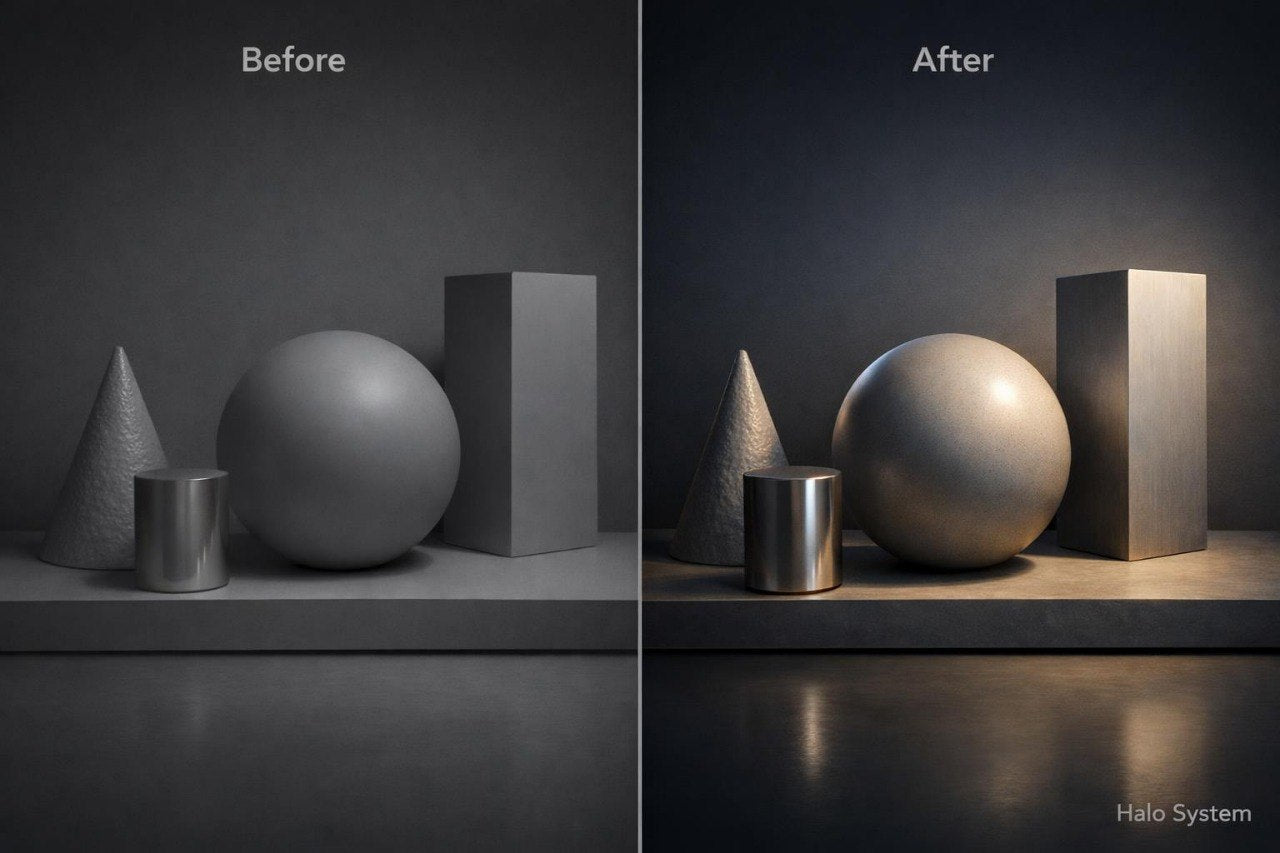
Struggling to light a 3D scene in a way that keeps every element readable and connected? You are not alone: lighting is often added near the end of the process, after the composition, materials, and object placement have already been developed without a lighting structure. This can cause forms to disappear into shadow, surfaces to look too similar, and the primary object to blend into its surroundings. Using too many light sources can also reduce depth and make the scene appear visually flat. Halo System explains how to plan lighting alongside composition and treat it as a central design element.
2. Solution
This course will teach you to examine a scene through its light, middle, and dark value areas. You will explore how lighting direction, size, distance, and character affect the appearance of objects. Dedicated modules cover shadows, reflections, color temperature, and lighting for different surface types. Practical exercises guide you through several lighting versions of one composition and help you compare their readability. For the final project, you will prepare a connected scene sequence with varied atmospheres and one consistent object structure.
3. What’s Inside
Module 1: Reading Light and Shadow
Learn to identify primary illumination, supporting light areas, reflected light, and shadow zones. This module helps you examine a lighting structure before developing the full scene.
Module 2: Direction and Form
Compare frontal, side, overhead, and back lighting. Practical examples show how each direction changes the perception of volume and silhouette.
Module 3: Soft and Defined Shadows
Examine the difference between soft and clearly defined shadows. You will study how shadow character affects perceived distance, scale, and atmosphere.
Module 4: Lighting Material Surfaces
Work with matte, smooth, textured, and reflective surfaces. The exercises show how one lighting arrangement interacts differently with each material type.
Module 5: Color and Temperature
Explore warm, cool, and neutral lighting relationships. The module demonstrates how lighting color can separate spatial layers and support the mood of a scene.
Module 6: Depth Through Illumination
Learn how brightness, contrast, and lighting direction can separate the foreground, middle ground, and background.
Module 7: Reflections and Highlights
Study reflections, highlights, and illuminated accents. You will examine where these elements clarify form and where they compete with the main focus.
Module 8: Lighting Variations
Prepare three lighting versions of one composition: calm, contrasting, and soft. You will compare each version using defined composition criteria.
Module 9: Halo Atmosphere Project
Create three connected frames using the same objects under different lighting conditions. Each frame should maintain a clear focal point, readable forms, and spatial depth.
4. Who Is This For?
✅ A good fit if you:
- have already created 3D scenes with several elements;
- want to study light and shadow in greater detail;
- work with different types of surfaces;
- want to create several atmospheric versions of one scene;
- are ready to review lighting with defined criteria.
❌ Not a fit if you:
- have not yet studied composition and spatial layers;
- need only a brief introduction to 3D design;
- do not plan to complete practical exercises;
- require individual guidance throughout every module;
- need materials tied to a named digital environment.
5. What You’ll Learn
After working through the course materials, you will be able to:
- identify the main lighting areas within a scene;
- compare four common lighting directions;
- control soft and defined shadow relationships;
- select lighting approaches for different surfaces;
- use warm and cool lighting combinations;
- separate several spatial layers;
- place a lighting emphasis on the main object;
- prepare three lighting versions of one scene;
- examine reflections and highlights;
- present a connected series of atmospheric frames.
6. 30-Day Refund Policy
Halo System includes a 30-day period for submitting a refund request under the terms published on the Orxivar website. Requests should be sent within the stated period and include the relevant order details. Learners should review the complete policy, request procedure, and possible exceptions before placing an order.
7. Certificate
After completing all required modules and the final project, learners receive a digital Orxivar certificate. The document includes the course title and the main topics related to lighting, materials, and atmospheric scene development.
1. What format do the courses use?
1. What format do the courses use?
Orxivar courses are divided into ordered modules with written explanations, visual examples, and practical exercises. Learners can study at their own pace and return to earlier topics whenever further review is helpful.
2. Do I need previous 3D visual design experience?
2. Do I need previous 3D visual design experience?
This depends on the selected plan and its curriculum. Introductory plans cover foundational concepts, while broader plans explore detailed scenes, visual structure, and more advanced design topics.
3. How long does a course take?
3. How long does a course take?
The study period depends on your schedule, the number of modules, and the time you dedicate to practice. Topics are arranged in a clear sequence, allowing you to study them in manageable sections.
4. Is a certificate included?
4. Is a certificate included?
Yes. After completing all required sections and assigned activities, learners receive a digital Orxivar certificate showing the name of the completed course.
Share