Orxivar
Free Kit
Free Kit
Couldn't load pickup availability
Self-paced learning overview
- 📥 Digital file available after purchase
- ♾️ Long-term availability
- 🔒 Secure checkout
- 🗓️ Content updated in 2026
1. Problem Statement
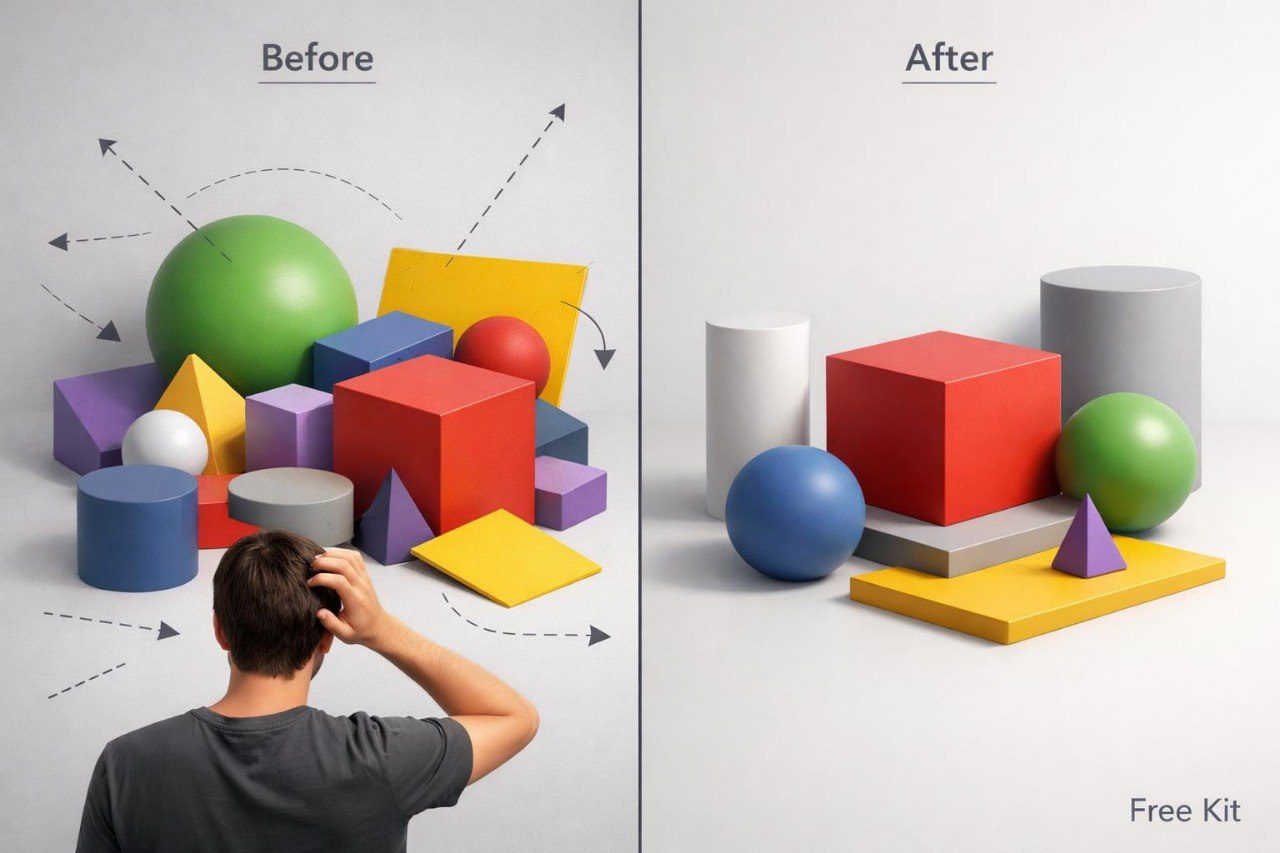
Struggling to understand where to begin with 3D visual design? You are not alone: unfamiliar terminology, spatial thinking, and numerous design decisions can make the subject feel disconnected. New learners may focus on individual objects without noticing how scale, proportion, and placement affect the complete composition. As a result, a scene may appear crowded, flat, or visually unbalanced. Free Kit provides a calm introduction to the foundations without placing too many topics into one stage.
2. Solution
This introductory course will teach you to view a 3D scene as a system of connected elements. You will learn how basic shapes can form the foundation of objects and compositions. The materials explain the role of scale, depth, lighting, and visual hierarchy. Focused exercises allow you to apply each concept in a small practical task. By the end, you will have a structured understanding of the main stages involved in creating a basic 3D composition.
3. What’s Inside
Module 1: Thinking in Volume
Explore planes, volume, silhouettes, and spatial placement. This module explains how to observe a form from different angles and compare the relationships between its parts.
Module 2: Building with Basic Forms
Learn how cubes, spheres, cylinders, and other foundational shapes can be combined into more detailed objects. The module covers proportion, scale, and silhouette readability.
Module 3: Space and Composition
Study object placement, negative space, focal points, and visual balance. You will arrange several elements into a small scene and review its overall structure.
Module 4: Light, Shadow, and Depth
Examine how the direction of light influences form, depth, and atmosphere. Visual examples compare soft lighting with more defined light and shadow relationships.
Module 5: Final Composition Exercise
Combine basic forms, composition, and lighting in one small scene. A review checklist is included to help you examine each design decision.
4. Who Is This For?
✅ A good fit if you:
- are beginning to explore 3D visual design;
- want to understand foundational terminology;
- are interested in form, space, and composition;
- prefer focused modules with clear topics;
- want to explore the Orxivar learning format before selecting a broader plan.
❌ Not a fit if you:
- need an advanced technical curriculum;
- expect a large collection of complex projects;
- already create detailed multi-object scenes;
- require individual instructor guidance;
- are looking for training tied to named software or operating systems.
5. What You’ll Learn
After working through the materials, you will be able to:
- identify foundational types of 3D forms;
- examine object silhouettes and proportions;
- arrange several elements within one scene;
- define the main visual focal point;
- use negative space within a composition;
- explain how scale affects visual perception;
- compare different lighting directions;
- create a composition with three or more forms;
- review a scene using a structured checklist;
- prepare for the topics presented in the next Orxivar plan.
6. 30-Day Refund Policy
Free Kit does not require payment, so a refund request is not needed for this plan. Paid Orxivar plans may include a 30-day period for submitting a refund request under the terms published on the website. Learners should review the applicable conditions, exceptions, and request procedure before placing an order.
7. Certificate
After completing all required modules and the final composition exercise, you will receive a digital Orxivar certificate. It will display the course title and confirm that the listed learning materials were completed.
1. What format do the courses use?
1. What format do the courses use?
Orxivar courses are divided into ordered modules with written explanations, visual examples, and practical exercises. Learners can study at their own pace and return to earlier topics whenever further review is helpful.
2. Do I need previous 3D visual design experience?
2. Do I need previous 3D visual design experience?
This depends on the selected plan and its curriculum. Introductory plans cover foundational concepts, while broader plans explore detailed scenes, visual structure, and more advanced design topics.
3. How long does a course take?
3. How long does a course take?
The study period depends on your schedule, the number of modules, and the time you dedicate to practice. Topics are arranged in a clear sequence, allowing you to study them in manageable sections.
4. Is a certificate included?
4. Is a certificate included?
Yes. After completing all required sections and assigned activities, learners receive a digital Orxivar certificate showing the name of the completed course.
Share