Orxivar
Flux Bundle
Flux Bundle
Couldn't load pickup availability
Self-paced learning overview
- 📥 Digital file available after purchase
- ♾️ Long-term availability
- 🔒 Secure checkout
- 🗓️ Content updated in 2026
1. Problem Statement
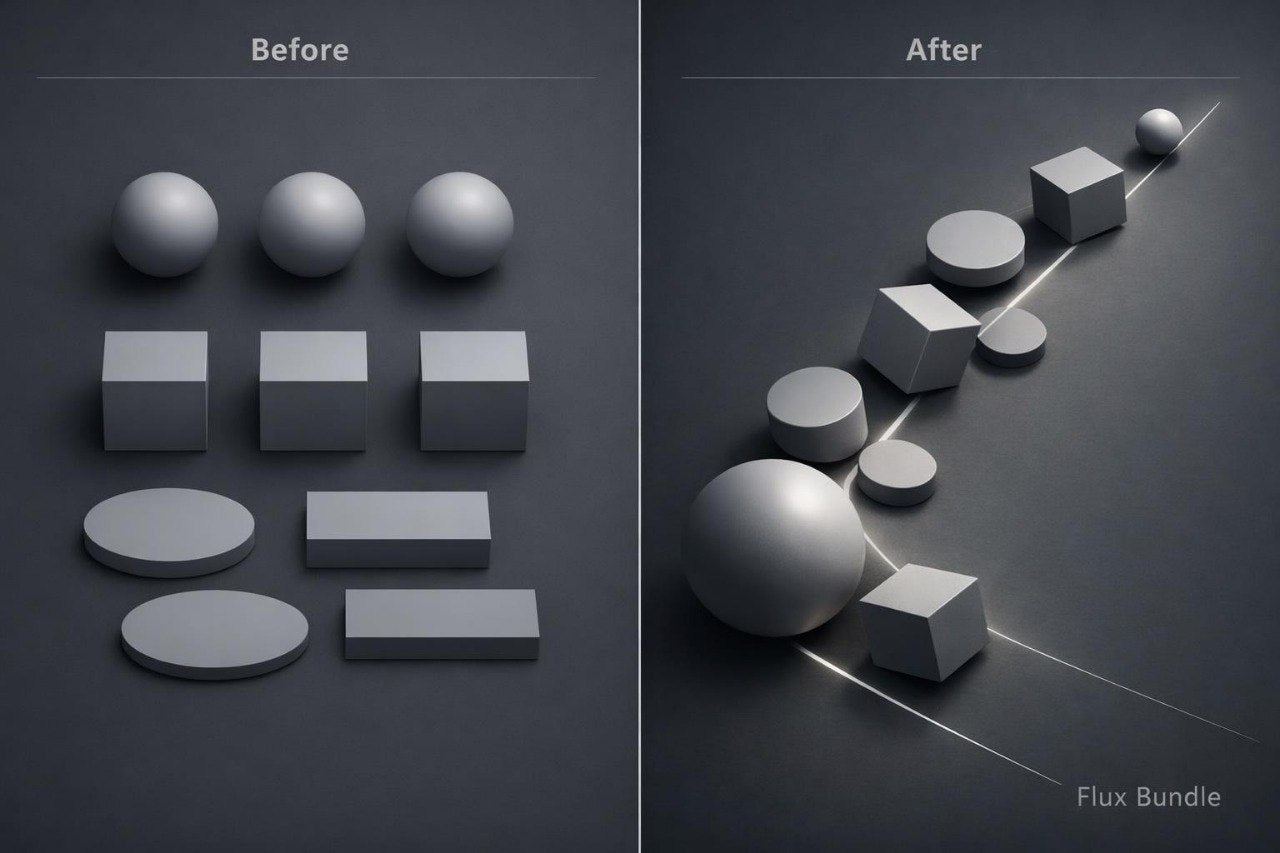
Struggling to make a 3D composition feel dynamic without filling it with excessive detail? You are not alone: a scene may contain thoughtfully built objects and still feel static because of repeated directions, uniform spacing, or the absence of visual development. Randomly shifting forms does not always communicate movement and may weaken the overall balance. It can also be difficult to show change across several frames while maintaining a connected visual style and readable sequence. Flux Bundle explains how to build movement through composition rather than through an excessive number of decorative elements.
2. Solution
This course will teach you to create visual movement through direction, scale transitions, spacing, and relationships between forms. You will explore how diagonals, repetition, and changing object positions can guide the viewer through a scene. Dedicated modules cover frame-to-frame transitions, lighting within dynamic compositions, and the use of contrast. Practical exercises help you compare static and movement-focused versions of one idea. For the final project, you will create a sequence of four connected scenes that communicate gradual change.
3. What’s Inside
Module 1: Direction and Visual Flow
Explore horizontal, vertical, diagonal, and circular directions. This module explains how the placement of forms and lines influences the viewer’s path through a composition.
Module 2: Dynamic Balance
Examine how movement and balance can work together without complete symmetry. Practical examples show how objects of different sizes can support one connected scene structure.
Module 3: Scale Transitions
Study gradual changes in scale, distance, and element density. You will create several compositions in which object size supports direction and spatial depth.
Module 4: Repetition with Variation
Explore repetition with small changes in form, placement, rotation, and proportion. These methods help create rhythm without making the scene feel repetitive.
Module 5: Light Across Movement
Learn how lighting can emphasize direction, change, and the main compositional focus. You will compare several lighting arrangements for one dynamic scene.
Module 6: Scene-to-Scene Continuity
Study how repeated forms, connected lighting, and consistent scale can link several frames. The module gives particular attention to readable visual transitions.
Module 7: Contrast and Tension
Examine contrast in size, direction, lighting, and density. This module shows how visual tension can be introduced while preserving clarity.
Module 8: Flux Sequence Project
Prepare four connected scenes for the final assignment. The sequence should communicate compositional change, maintain a shared visual style, and follow a clear viewing direction.
4. Who Is This For?
✅ A good fit if you:
- have already studied composition and perspective;
- want to communicate movement through form and placement;
- plan to create connected frame sequences;
- are interested in rhythm, contrast, and dynamic balance;
- are ready to compare several versions of one idea.
❌ Not a fit if you:
- are only beginning to study foundational forms;
- need materials focused entirely on technical settings;
- do not plan to work with scene sequences;
- require personal guidance for every exercise;
- need a course tied to a named digital environment.
5. What You’ll Learn
After working through the course materials, you will be able to:
- create directional movement through object placement;
- use diagonals and repetition within a composition;
- combine dynamic structure with visual balance;
- build scale transitions between scene elements;
- create rhythm through repeated forms with variation;
- compare static and movement-focused scene versions;
- maintain connected lighting across several frames;
- introduce contrast without overcrowding the composition;
- prepare a sequence of four related scenes;
- review frame continuity using defined criteria.
6. 30-Day Refund Policy
Flux Bundle includes a 30-day period for submitting a refund request under the terms published on the Orxivar website. Requests should be sent within the stated period and include the relevant order information. Learners should review the complete policy, submission procedure, and possible exceptions before placing an order.
7. Certificate
After completing all required modules and the final sequence project, learners receive a digital Orxivar certificate. The document lists the course title and the main subject areas covered within the curriculum.
1. What format do the courses use?
1. What format do the courses use?
Orxivar courses are divided into ordered modules with written explanations, visual examples, and practical exercises. Learners can study at their own pace and return to earlier topics whenever further review is helpful.
2. Do I need previous 3D visual design experience?
2. Do I need previous 3D visual design experience?
This depends on the selected plan and its curriculum. Introductory plans cover foundational concepts, while broader plans explore detailed scenes, visual structure, and more advanced design topics.
3. How long does a course take?
3. How long does a course take?
The study period depends on your schedule, the number of modules, and the time you dedicate to practice. Topics are arranged in a clear sequence, allowing you to study them in manageable sections.
4. Is a certificate included?
4. Is a certificate included?
Yes. After completing all required sections and assigned activities, learners receive a digital Orxivar certificate showing the name of the completed course.
Share